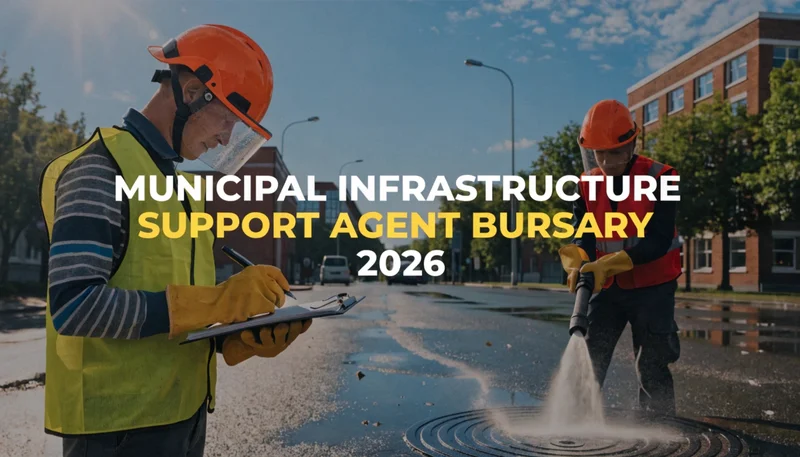
The Municipal Infrastructure Support Agent (MISA) offers a Technical Bursary Scheme aimed at supporting financially needy South African students who are studying – or planning to study – in built environment fields.
This bursary plays a critical role in strengthening local government capacity by developing skilled professionals who will contribute to infrastructure planning, operations, and maintenance in municipalities.
In this article, we break down everything you need to know about the MISA Bursary, including fields of study, eligibility criteria, application process, and the closing date.
About the MISA Bursary Programme
The MISA Technical Bursary Scheme targets students pursuing technical professions in the built environment. MISA’s primary mandate is to help municipalities improve infrastructure delivery and service provision. To achieve this, the agency invests in developing engineers, planners, and other technical specialists who will eventually support local government.
Through this bursary programme, MISA aims to:
-
Build a strong pipeline of technical professionals
-
Strengthen municipal infrastructure capacity
-
Support students from disadvantaged backgrounds
-
Promote transformation within the built environment sector
The programme is specifically designed for students studying at public institutions in South Africa, including universities, universities of technology, and TVET colleges.
Fields of Study Funded
The MISA Bursary supports studies in various built environment disciplines. According to available bursary information, funded fields include:
-
Civil Engineering
-
Electrical Engineering
-
Project and Construction Management
-
Urban and Regional Planning
-
Environmental Management
These qualifications are directly aligned with municipal infrastructure development needs across the country.
Who Can Apply? (Eligibility Criteria)
Before applying, you must meet the minimum entry requirements. Failure to meet all criteria may result in your application not being considered.
To qualify, applicants must:
-
Be a South African citizen
-
Be currently in Matric or have completed Matric
-
Be studying or intending to study towards an undergraduate qualification in one of the approved fields
-
Be registered or accepted at a recognised public tertiary institution in South Africa (University, University of Technology, or TVET College)
-
Have a total combined household income of less than R600 000 per annum
-
Have passed all courses from the previous academic year (if currently studying)
Preference is Given To:
MISA prioritises certain categories of students, including:
-
Youth from rural areas
-
Individuals from previously disadvantaged communities
-
Students with disabilities
This focus ensures that the bursary reaches students who may otherwise struggle to access funding.
Required Supporting Documents
When applying, you must submit all required documentation. Applications missing supporting documents may be rejected.
Required documents include:
-
Certified copy of South African ID
-
Certified copy of Matric certificate or latest Grade 12 results
-
Academic transcripts (if currently studying)
-
Proof of registration or acceptance (on institutional letterhead)
-
Proof of residence
-
Proof of household income (affidavits, payslips, or proof of unemployment)
-
Financial statement from your institution (if already studying)
Make sure all copies are certified and clearly legible.
How to Apply for the MISA Bursary
The application process is straightforward but must be followed carefully.
-
Download and complete the official MISA Bursary Application Form (PDF).
-
Submit your completed application together with all supporting documents via email to:
CB.bursaries2026@misa.gov.za -
Use your discipline/study field as the email subject line.
-
Address your application to Ms Nobuhle Latha or Ms Thulisile Mosoeu
Important notes:
-
No faxed, hand-delivered, or postal applications will be accepted
-
Only successful applicants will be contacted
If you do not receive feedback within a reasonable period after the closing date, you should consider your application unsuccessful.
Closing Date
For the 2026 academic cycle, the closing date for the MISA Bursary is 07 March 2026.
Applications submitted after the closing date are not accepted, so it is crucial to apply early once the new cycle opens.
If you are planning to apply in the next intake, keep checking official MISA platforms and reputable bursary websites for updated opening and closing dates.
Why Consider the MISA Bursary?
Unlike general bursaries, the MISA Bursary is strategically aligned with South Africa’s infrastructure development goals. Graduates funded through this scheme are positioned to contribute directly to municipal infrastructure planning, maintenance, and service delivery.
In addition, MISA does more than just provide funding. The agency is involved in deploying technical capacity such as engineers, town planners, and project managers to municipalities across the country. This means beneficiaries may benefit from exposure to real municipal infrastructure environments.
For students who want to:
-
Build a career in civil or electrical engineering
-
Work in municipal infrastructure
-
Contribute to improving service delivery in communities
-
Gain practical exposure in the public sector
This bursary can open valuable doors.
Contact Details for Enquiries
If you have questions about the bursary, you may contact MISA directly:
-
Ms Nobuhle Latha: 012 848 5529
-
Ms Thulisile Mosoeu: 012 848 5515
-
Email: CB.bursaries2026@misa.gov.za
Always ensure that you contact the official channels listed in the bursary advert.
Final Thoughts
The MISA Bursary is a fantastic opportunity for students pursuing built environment qualifications in South Africa. With a strong focus on rural development, transformation, and infrastructure capacity building, the programme not only funds studies but also supports national development goals.
If you meet the eligibility requirements and are passionate about engineering, planning, or environmental management, this bursary is worth applying for.
Keep your documents ready, monitor application opening dates, and apply before the deadline. Funding opportunities like this can significantly reduce the financial burden of tertiary education while positioning you for a meaningful career in municipal infrastructure.